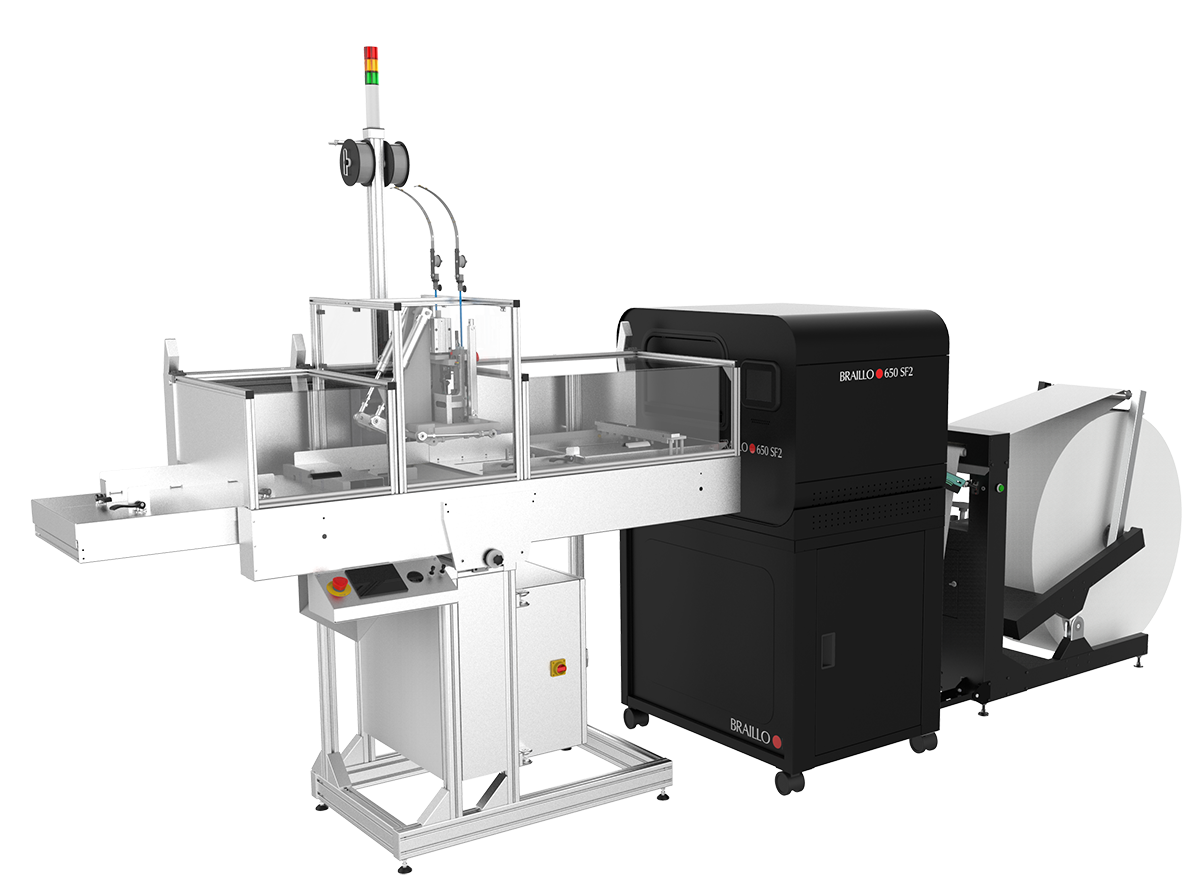
Since introducing the world’s first interpoint production braille embosser in 1980, Braillo has focused on engineering embossers capable of producing high-quality braille—consistently, reliably, and over extended production cycles.
Production braille embossing requires a level of precision and durability that goes beyond standard printing. Braille quality is defined by three critical factors: dot shape, dot height, and dot alignment.
Braille Dot Shape
Dot shape is fundamental to readability. Consistent, well-formed dots provide a predictable tactile experience, allowing readers to move efficiently across the page.
Braillo embossers form dots by applying controlled pressure through hardened steel pins into heavy-duty printing shoes. This ensures that each dot is uniform, rounded, and clearly defined. During subsequent embossing cycles, these printing shoes support previously formed dots, preventing deformation and preserving their structure.
Maintaining consistent dot shape ensures that braille remains clear and easy to interpret throughout the entire document.
Braille Dot Height
Dot height is governed by established standards to ensure readability. In North America, Specification 800 defines a nominal dot height of 0.48 mm, with consistency required across the entire transcription.
Maintaining this standard at production speeds requires precision engineering. Braillo embossers use a mechanical embossing system in which magnets engage a lever to form each dot. These systems are isolated from the physical forces of embossing, allowing for consistent performance over extended operation.
The result is stable, uniform dot height across long production runs.
Braille Dot Alignment
Accurate dot placement is essential for readability. Each braille cell must maintain precise spacing and alignment so that characters can be easily recognized.
Braillo production embossers use multiple fixed embossing systems to form an entire line of braille in a single cycle. This ensures that dots are consistently aligned within each cell and across the page, maintaining clarity throughout the document.
Investing in Long-Term Braille Quality
When evaluating a production braille embosser, performance should be measured over time—not just at initial output. Speed, durability, and consistent braille quality all contribute to long-term value.
Braillo embossers are engineered for sustained production environments, delivering consistent braille quality with minimal maintenance. This combination of precision engineering, durable components, and long-term reliability supports high-volume production while maintaining readability from the first page to the last.