
Braillo Braille Embossers - See What Sets Them Apart
If an embosser is not designed for sustained production, it is not a production braille embosser
Producing braille at high speeds while maintaining quality is a demanding mechanical process that requires a heavy-duty, precision-engineered braille printer. Unlike personal-use braille printers, a production braille printer is designed not only for speed but also for continuous operation—all day long, with users stopping only to reload paper once per hour (or, when using paper rolls, potentially only once per day). Personal braille printers, or competing production printers, are suitable for low-volume output and are great for individual use, but their construction and paper-handling methods are not designed to support the demands of large-scale braille production for businesses, schools, or government organizations.
This is why Braillo braille printers are the preferred choice for nearly all major braille production centers—they are specifically engineered to handle the rigorous requirements of true braille production. Production braille printing is far more demanding than consumer-level printing. Beyond manufacturer specifications, consider the quality of the printer, its components, and real customer references when evaluating your options.
To see the difference for yourself, compare the mechanical components of Braillo production printers with those of competitors. When critical parts fail, braille production stops. Side-by-side comparisons make it clear which printer you can trust to meet high-volume production demands. Click on any image to enlarge and observe the obvious: Braillo is in a class of its own for production braille printing.
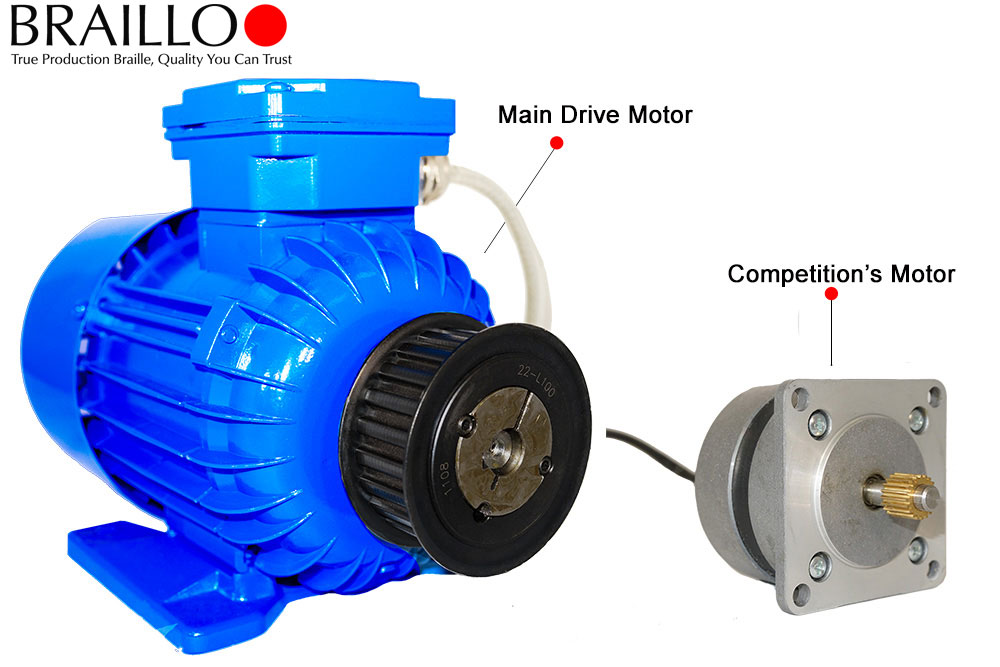
Braillo Main Motor vs. the Competition
Production braille printers require industrial-grade motors to handle the demanding workload of large-scale braille production. Braillo equips its printers with a powerful main motor to drive the printing mechanisms, while a separate, smaller motor manages the paper-handling components. In contrast, competitors rely on a single, lightweight stepper motor to power all operations.
Another key difference lies in the drive wheel size on each main motor shaft—a detail that significantly impacts performance and durability.
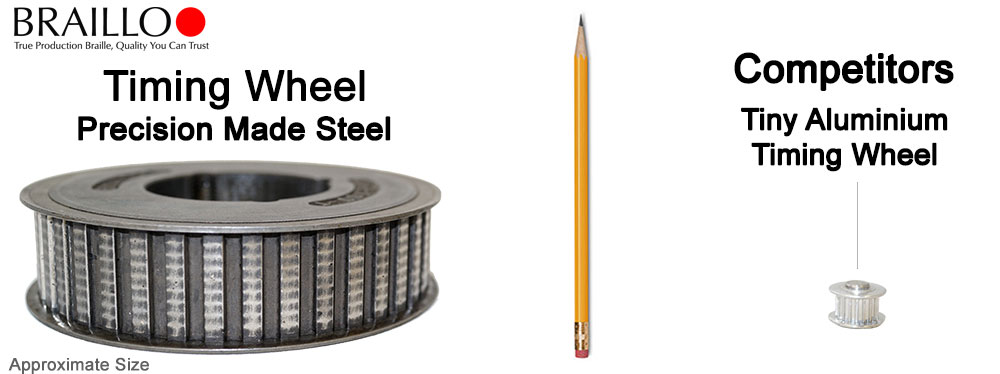
Braillo Timing Wheel vs. the Competition
The timing wheel is a critical component that controls the entire operation of a braille printer, ensuring precise dot alignment and proper spacing. Braillo uses two timing wheels made of case-hardened steel, which are significantly larger and more durable than the single, lightweight aluminum wheel used by competitors.
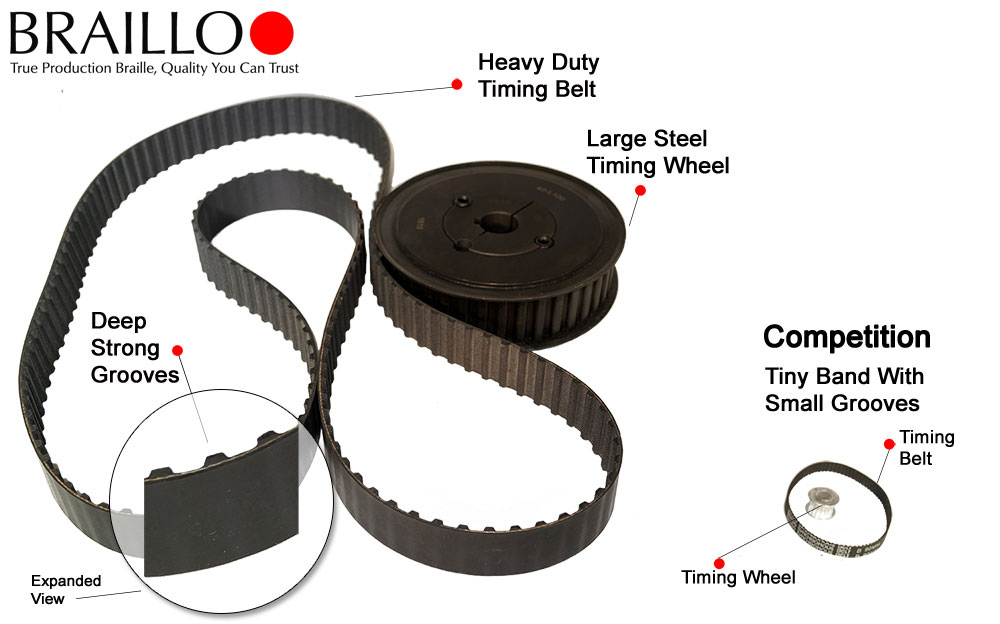
Braillo Timing Belt vs. the Competition
Working in tandem with the timing and drive wheels, the main drive/timing belt governs the printer’s operations. In a Braillo printer, this belt wraps around two sets of timing wheels and the main motor drive wheel, ensuring precise and synchronized movement.
High-speed braille production requires significant torque, so the belt must be exceptionally strong and durable. Braillo uses a heavy-duty, thick, flexible rubber belt designed for long-lasting performance, while competitors rely on a lightweight rubber band that cannot withstand the same demands.
Braillo Belt Tensioner vs. the Competition
Maintaining proper tension in the drive belt is essential for accurate braille line spacing and dot placement. A loose belt can lead to production errors, incorrect dot height or position, and even damage the printer.
Braillo addresses this with a thick, heavy-duty steel belt tensioner that delivers consistent, strong pressure. In contrast, competitors use a thin plastic tensioner that is prone to bending or breaking under even minimal stress.

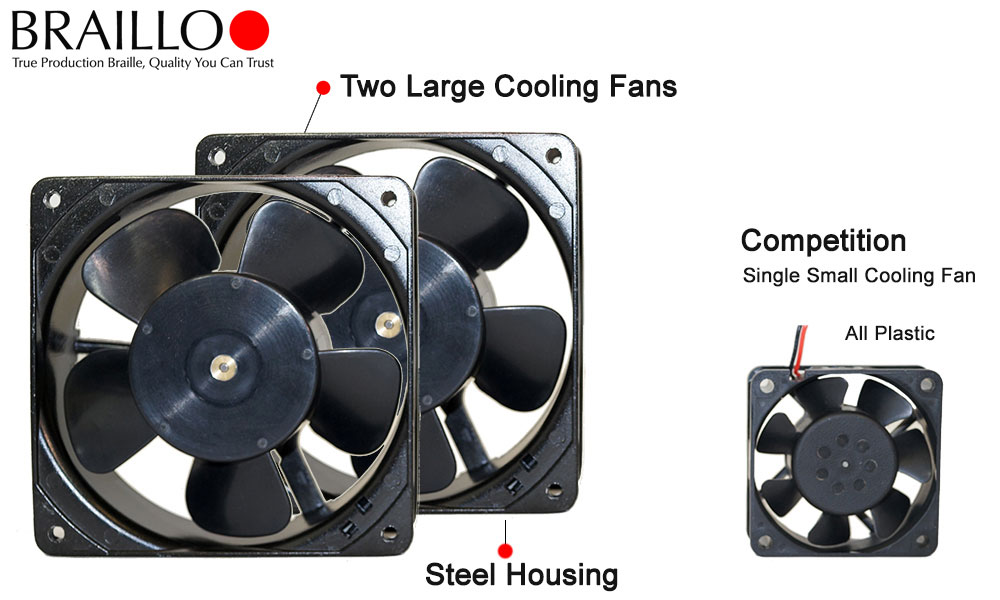
Braillo Cooling Fans vs. the Competition
Operating a production printer for extended hours generates heat, which can damage electrical components or force the user to pause production to let the machine cool down.
Braillo addresses this with two heavy-duty metal fans for efficient heat dissipation, while competitors rely on a single lightweight plastic fan, which provides far less cooling and is more prone to failure.
Braillo Tractor Belt vs. the Competition
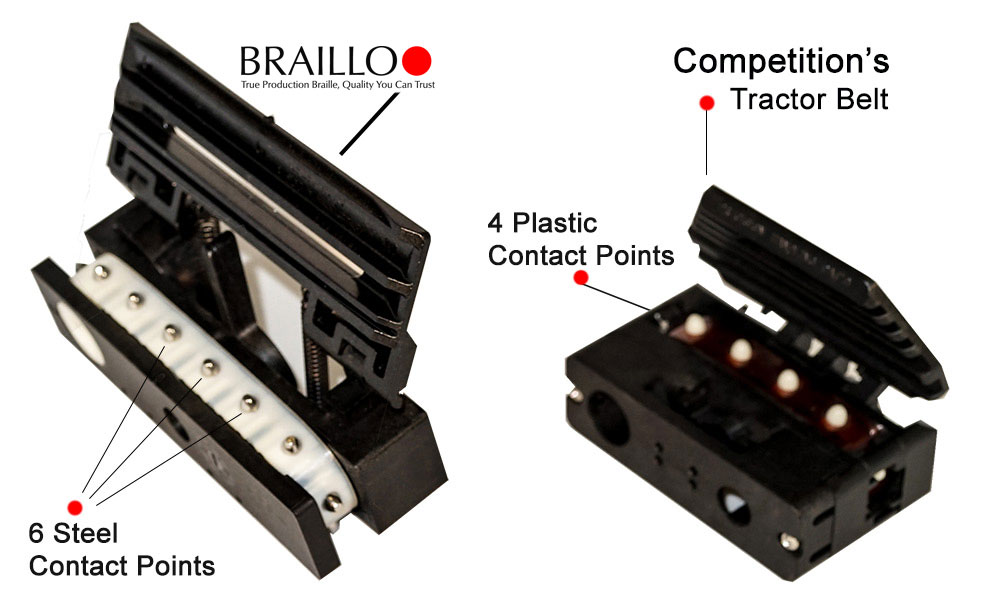
Tractor belts are responsible for feeding braille paper through the printer, making accurate paper movement essential for error-free production.
Braillo employs heavy-duty tractor feed units with six steel contact points and a robust belt mechanism, ensuring precise and reliable paper handling. Competitors, in contrast, use thin plastic belts with only four small plastic contact points, which can lead to paper misalignment, tearing, and production errors.
Perfectly Aligned Braillo Braille vs. the Competition
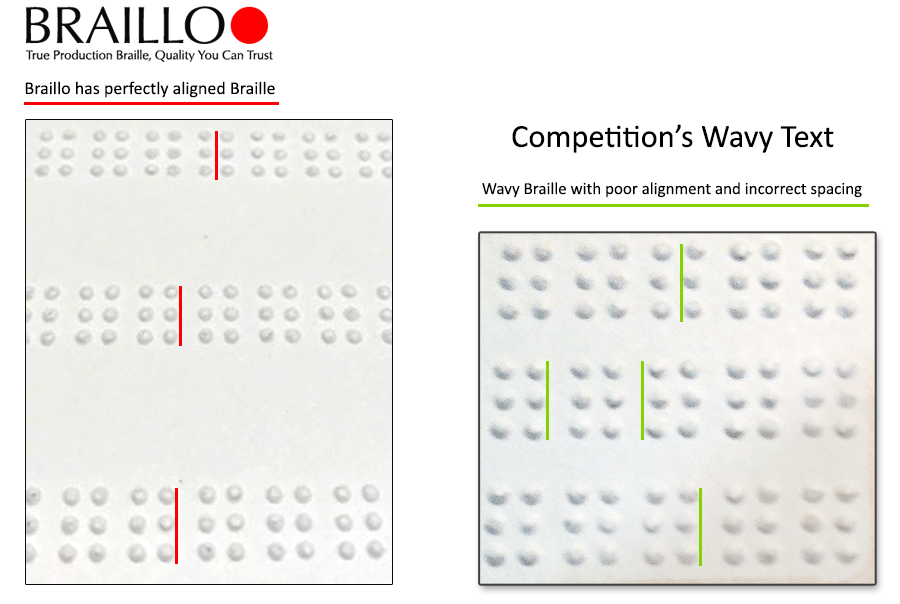
Braillo braille is widely recognized as the easiest to read—and the reason is simple: our braille is perfectly aligned, with each dot exactly where it should be. Braillo printers meet strict government standards, while many competitors do not. When braille is misaligned, readers must guess words or pause to re-read sentences, disrupting the reading experience.
A close look at the image reveals the difference: competitors’ braille output is often wavy, with dots misaligned within rows and columns, whereas Braillo dots are precisely positioned for maximum readability.
Investing In A Braillo Braille Printer
Braillo is the world’s leading manufacturer of true production braille printers. Designed for sustained, high-volume output, Braillo printers range from the Braillo 300 S2 to the Braillo 650 SF2—supporting large-scale production of braille books and magazines, including fully automated folding, covering, and stapling.
Braillo is often asked why its production braille printers are larger, heavier, and represent a greater initial investment than lower-cost alternatives. The answer is straightforward: Braillo printers are engineered for true production environments. Built with durable, high-performance components, they are designed to operate continuously, maintain consistent braille quality, and perform reliably over many years.
In contrast, many lower-cost systems are designed for personal or light-duty use, yet are positioned as production solutions. While the initial purchase price may be lower, these systems are not engineered for sustained throughput, consistent braille quality, or long-term durability. Over time, this results in increased downtime, higher maintenance requirements, inconsistent braille output, and more frequent replacement.
A Braillo printer is an investment in long-term performance, reliability, and braille quality. Many Braillo embossers installed in the 1980s remain in operation today—demonstrating a level of durability and consistency that defines true production braille.
