
Braille Embosser Speeds - How They Are Tested and Manipulated
Embossing speed – an explanation as to why Braillo is accurate and others are not
Among the many performance specifications promoted by braille embosser manufacturers, speed is often highlighted as one of the most important. On the surface, this makes sense: faster embossing means higher output, allowing more documents to be produced in less time. Speed also seems easy to quantify—simply measure how many braille dots are embossed in a given period.
However, in practice, many manufacturers take significant liberties in defining and measuring “speed.” Consider the following:
-
Is speed meaningful if the resulting braille is difficult to read?
-
Can you truly call it a speed test if it only involves embossing the same letter repeatedly?
-
How long can the embosser maintain that speed? Producing a few minutes of braille at high speed and low quality is easy. Maintaining high speed with perfect quality, hour after hour, is an entirely different challenge.
How to HONESTLY test and evaluate embossing speed that still maintains braille quality
Measurements
Embosser speeds are measured in CPS – Character Per Second, or PPH – Pages Per Hour.
These key attributes of a braille embosser should be simple to understand and measure, yet some manufacturers are misleading in how they report and calculate their speeds.
Pages Per Hour (PPH):
PPH is straightforward—it measures how many braille pages an embosser can produce in an hour. An honest test involves printing real text transcribed from a book or document for 60 minutes and counting the resulting pages. Naturally, PPH can vary depending on sheet size, paper margins, and, for printers using paper rolls, the cutting time.
However, some manufacturers report inflated PPH by running the Form Feed command without sending any text to be embossed. Essentially, this feeds blank pages quickly, resulting in an unrealistically high PPH. Others may emboss only a paragraph per page instead of a full page of text, producing similarly misleading results.
When Braillo reports PPH, it is always based on embossing a full page of normal text for an hour. This provides an honest, real-world measurement that can be consistently replicated.
Beyond PPH, the true measure of a production braille embosser is the quality of its components and engineering. Solenoid-based embossers—or configurations that combine multiple solenoid units in a larger enclosure—cannot reliably withstand the demands of high-volume braille production. Only a Braillo is built for this level of rigorous use.
Characters Per Second (CPS):
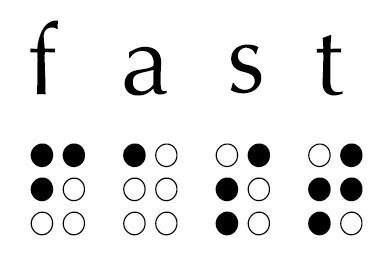
CPS measures how many braille characters an embosser can produce per second. A braille cell contains six dots, and each dot is essential to forming a proper character. http://www.brailleauthority.org/learn/braillebasic.pdf
Some competitors determine CPS by embossing a page filled with the letter “a,” which uses only one dot per cell. For example, an embosser might claim 300 CPS, but this only accounts for single-dot characters—not full braille cells.
To achieve a true CPS of 300, an embosser must produce 300 characters per second, with each character consisting of six dots—totaling 1,800 braille dots per second. This is the standard Braillo uses to determine and report speed.
As with PPH, look beyond advertised numbers. Examine the embosser’s construction, components, and real customer experiences. High-volume braille production demands the engineering and durability found only in a Braillo. Inexpensive solenoid-based embossers, or setups that combine solenoids into a larger enclosure simply cannot meet these requirements.
Interested in the technical details when determining speed?
Some competitors make speed claims that are not only exaggerated but physically impossible. Consider this example:
Braillo’s slowest embosser, the 300 S2, produces is 300 CPS and produces 1,800 dots per second (DPS). With 168 dedicated printing mechanisms, each mechanism embosses at 10.71 rows of braille dots per second (1,800 DPS ÷ 168 mechanisms = 10.71 rows/sec). Each cycle embosses a complete row of dots on both sides of the page—one line at a time. At this frequency, the 300 S2 can emboss 3.33 full lines of 84 braille cells every 3.57 seconds, equivalent to 299.88 CPS.
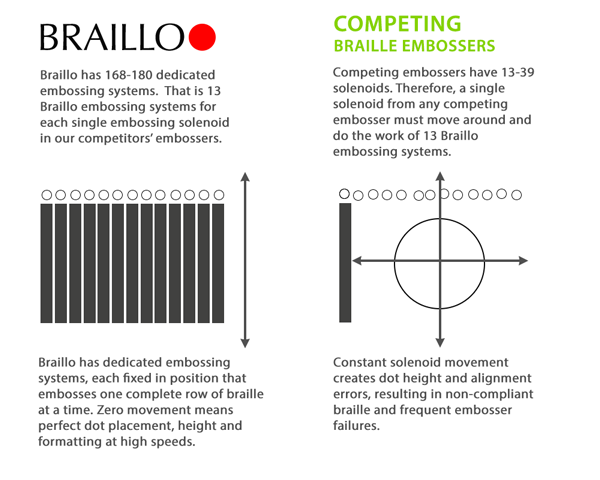
By comparison, a competitor claims their competing embosser is 330 CPS, but uses only 39 solenoids divided among three embosser heads. To achieve 1,980 braille dots per second (330 CPS × 6 dots per character), each solenoid would need to emboss a dot and then move—potentially across the full width of the page—to the next dot location, repeating this 50.76 times per second (1,980 ÷ 39 = 50.76). This is physically impossible. Many of these competing embossers fail under such conditions because their solenoid-based construction is simply not built to handle the demands of true production-grade braille.
Do not purchase a braille embosser without verifying that the manufacturer can achieve their claimed speeds—embossing full braille cells for at least 1,000 pages without compromising dot quality. We encourage you to test any Braillo against the competition and see the difference for yourself.
Braille embossing speed is a critical feature, but true value comes from maintaining high-quality braille over long periods of continuous operation. High-speed embossing with consistent quality increases the efficiency and profitability of your operations. This is why some manufacturers exaggerate their speed claims. Only Braillo has the engineering, and uses the necessary components, to build production-grade embossers capable of sustaining real, high-speed performance without sacrificing quality.
